
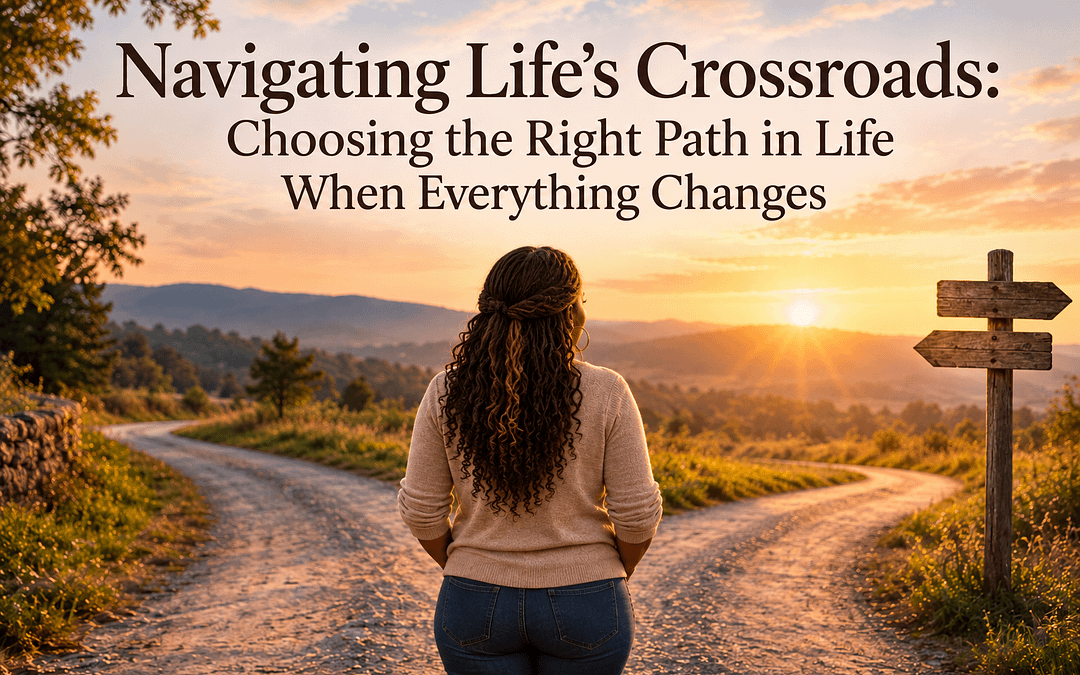
When life suddenly changes, choosing the right path in life when we are at a crossroads can shape where we go next. Sometimes choosing the right path means taking just one step toward healing, faith, and hope.
There are moments in life when everything changes so quickly that we don’t even realize we are standing at a crossroads.
The day after I lost my son in 2017, I woke up in more pain than I knew how to carry. I didn’t want answers. I didn’t want someone to tell me that everything was going to be okay.
I just wanted the pain to stop.
As I’ve shared before, addiction has affected generations of my family. Drug and alcohol abuse were paths I had deliberately stayed away from throughout my life, in part because of a promise I made to my grandmother.
But grief has a way of bringing you to places you never imagined you would be.
In those first hours after losing my son, thoughts of numbing the pain surfaced. I was desperate to feel nothing—even if only temporarily.
I didn’t recognize it at the time, but I was standing at one of the most important crossroads of my life.
One path offered an escape. It wouldn’t have taken away my grief. It wouldn’t have brought my son back. But maybe, for a little while, I wouldn’t have had to feel what I was feeling.
The other path didn’t offer an escape at all.
It meant feeling the pain.
It meant grieving.
And eventually, it meant turning toward God—even though I was deeply angry with Him.
I didn’t understand why God had allowed my son to be taken from me. I wasn’t thinking about purpose. I wasn’t searching for some profound lesson in what had happened.
I was a mother whose 17-year-old son was gone, and I was hurting.
But in those early moments of my grief, God placed two people in my path.
They couldn’t take away what had happened. They couldn’t make my grief disappear or give me the answers I desperately wanted. But they were there at a moment when I needed people around me—when I needed something to interrupt the direction my thoughts were beginning to take me.
Looking back now, I don’t believe their presence at that particular moment was an accident.
They helped me take another step.
And then another.
I didn’t suddenly stop hurting. I didn’t suddenly understand why this had happened. But I began moving in a different direction.
That experience taught me something about choosing the right path in life that I don’t think I completely understood before.
Sometimes the crossroads doesn’t arrive when we’re calm, prepared, and thinking clearly.
Sometimes it finds us when we’re hurting.
Life Is Filled With Crossroads
Not every crossroads will look like mine.
Sometimes they’re created by tragedy. Other times they come through relationships, disappointment, mistakes, opportunities, fear, career decisions, family problems, or circumstances completely outside our control.
And sometimes we don’t even recognize a crossroads until years later.
We look back and realize:
That decision changed something.
We don’t always get to choose what happens to us. But eventually, there are moments when we have to decide what we’re going to do with what happened.
That’s why choosing the right path in life isn’t always about having a perfect plan.
Sometimes it’s simply about making the next decision that moves you toward healing instead of away from it.
Pause Before You Choose Your Next Step
When something painful happens, it’s natural to want relief.
I know that feeling.
I didn’t want to process what had happened to me. I wanted the pain to stop.
But there’s a difference between relief and healing.
Relief asks:
What can make this stop hurting right now?
Healing asks:
What will help me continue living through this without destroying myself in the process?
Those are very different questions.
When we’re overwhelmed, afraid, angry, or heartbroken, we don’t necessarily need to figure out the rest of our lives.
Sometimes we simply need to pause long enough to avoid making a permanent decision based on a temporary moment of desperation.
You don’t have to solve tomorrow today.
Sometimes the next right step is simply not taking the wrong one.
Be Completely Honest About What You’re Feeling
I was angry with God.
That’s part of my story.
I could dress that up now and make it sound more spiritual, but that wouldn’t be truthful.
I had lost my son.
I prayed. I believed in God. And yet my child was gone.
I had questions.
I had anger.
I had pain that I didn’t know what to do with.
What I eventually learned was that I didn’t have to hide any of that from God.
I could pray while angry.
I could cry while questioning.
I could tell God that I didn’t understand.
My faith didn’t require me to pretend that I was okay when I wasn’t.
And sometimes that’s an important part of choosing the right path in life—being honest about where you actually are instead of pretending you’re somewhere else.
Naming your pain doesn’t magically take it away. But acknowledging what you’re carrying can help prevent those feelings from quietly making your decisions for you.
Pay Attention to Who Shows Up at the Crossroads
One of the things I remember most about that period of my life is that I wasn’t left completely alone at my crossroads.
Those two people showed up.
They didn’t arrive with a map for the rest of my life.
They didn’t fix me.
They didn’t erase my grief.
They simply became part of what helped redirect me when I was vulnerable.
Sometimes we’re waiting for God to change the entire situation when He’s already sending us enough help to take the next step.
It may be a family member.
A friend.
A pastor.
A counselor.
Or someone you never expected to play an important role in your life.
Pay attention to the people who show up.
And when you know you’re struggling, don’t be afraid to tell someone you trust that you need them.
You don’t have to walk through every crossroads alone.
The Right Path Isn’t Always the Easier Path
I think this is something we sometimes misunderstand.
We assume that when we’ve made the right decision, things should immediately become easier.
That wasn’t my experience.
Choosing not to numb what I was feeling didn’t make my grief disappear.
Turning toward God didn’t suddenly make me understand why my son died.
Choosing a different direction didn’t mean the road ahead wasn’t going to hurt.
The right path can still be painful.
Sometimes the difference is that one path helps us eventually heal while the other only helps us temporarily escape.
That’s why choosing the right path in life sometimes requires us to look beyond what will make us feel better right now and consider where a decision may eventually lead.
A Wrong Turn Doesn’t Have to Become Your Destination
There’s something else I think is important to say.
Crossroads aren’t always one-time tests where you either make the right decision or ruin your life.
We’re human.
Sometimes we choose poorly.
Sometimes pain gets the better of us.
Sometimes we travel farther down a road than we ever intended.
That doesn’t mean we’re required to stay there.
A wrong turn doesn’t have to become your destination.
You can ask for help.
You can change direction.
You can come back to your faith.
You can make a different decision today than the one you made yesterday.
Grace leaves room for another choice.
Choosing the Right Path in Life One Step at a Time
Looking back on that morning after losing my son, I can see the crossroads much more clearly than I could while I was standing in it.
At the time, I wasn’t thinking:
This decision could affect the direction of my life.
I was simply hurting.
But that’s the thing about crossroads.
We don’t always recognize their importance while we’re standing in them.
Sometimes we only understand later how one person, one decision, one prayer, one phone call, or one moment of hesitation changed what happened next.
That’s why I don’t believe choosing the right path in life means knowing exactly where the road will lead.
Sometimes it means trusting God with what you can’t see and taking the next step you know you need to take.
A Prayer for Guidance at Life’s Crossroads

Walking Forward
If you’re standing at a crossroads today, you don’t have to figure out the rest of your life right now.
Pause.
Be honest about what you’re feeling.
Pay attention to the people who are trying to help you.
Pray—even if the only prayer you can manage is, “God, I don’t know what to do.”
And remember that the easiest road isn’t always the road that leads toward healing.
You may not have chosen what brought you to this crossroads.
But you still have a say in what happens next.

You only need enough courage to make the next decision that moves you toward healing rather than away from it.
And if you realize you’ve already taken a wrong turn, you can choose again.
Life’s crossroads rarely give us a full map of where the road ends; they usually only show us enough light for the very next step.
As you go about your day, take care, be well, and remember to live everyday life “very simple.” I’ll see you next time.