
What to do when you feel like a failure after letting someone down—and how to reclaim your purpose.
Recently, I accepted a project for a client. Going into it, I truly believed in my mind that I could complete it. I had the confidence, the desire, and the intention to deliver great work. But after diving in and actually attempting to complete the project, reality set in: I couldn’t do it. It just wasn’t possible.
Having to go back to the client and say, “I can’t complete this” broke my heart.
I felt physically sick and emotionally drained. In my mind, I hadn’t just hit a roadblock; I had completely failed. I felt like I had let my client down, destroyed their faith in my abilities, and ruined my reputation. That single situation put me into a dark, depressed mood that lasted for days. I was spiraling. In the middle of that pain, I made a short post on Facebook, simply sharing how much it hurts to fail.
The response reminded me of something crucial: I am not the only one who struggles with feeling like a failure. So many of us carry this heavy weight every day.
There are moments in life when we give something everything we’ve got and still fall short. Those moments leave us feeling discouraged, embarrassed, and wondering if we’re really capable of accomplishing anything at all.
Failure hurts because we care. We care about doing our best, keeping our promises, and honoring the trust people place in us. And when something doesn’t go the way we hoped, it’s easy to believe we’ve let everyone down—including ourselves.
Sometimes the disappointment lasts much longer than the moment itself. We replay the conversation in our heads. We rethink every decision that seemed perfectly reasonable at the time. And somewhere along the way, our thoughts shift from:
“I failed at something.”
to:
“I am a failure.”
There is a vital difference between those two statements.
What to Do When Disappointment Turns Into Self-Doubt
One of the hardest parts of a setback isn’t always what actually happened; it’s the toxic story we start telling ourselves afterward.
When I couldn’t finish that project, my mind immediately spiraled into worst-case scenarios:
- “I should have known better before taking this on.”
- “They’re never going to trust me again.”
- “Maybe I’m not as skilled as I thought I was.”
- “What if I fail the next client, too?”
Before we know it, one disappointing experience causes us to question everything we know about ourselves.
If you are spiraling right now, stop and remind yourself of this truth:
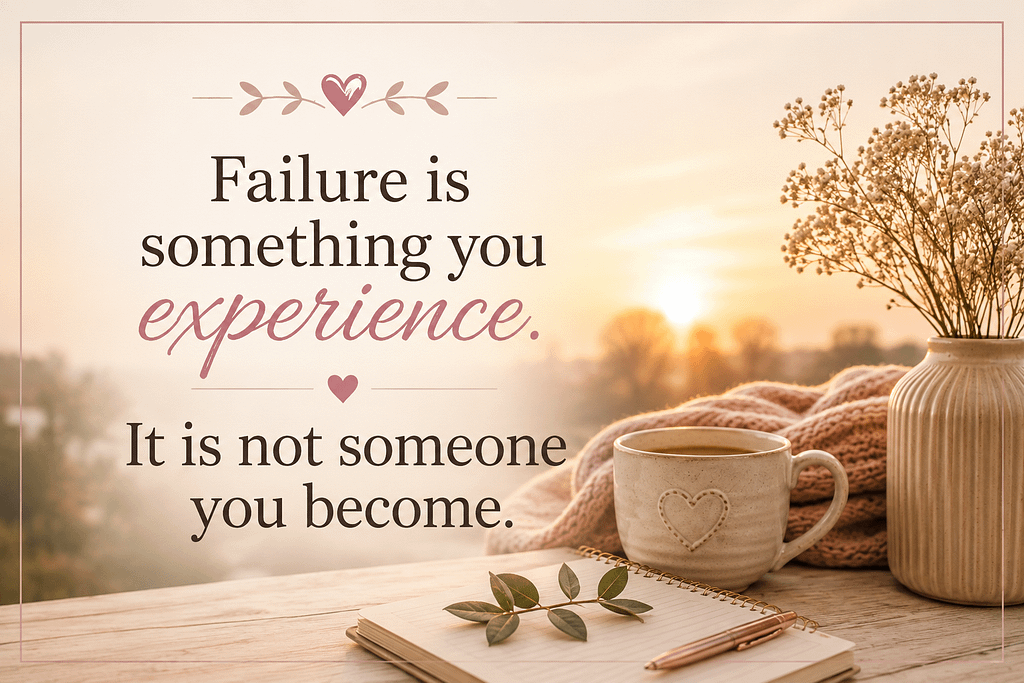
One uncompleted project doesn’t erase your talent. One mistake doesn’t erase years of accomplishments. One setback doesn’t suddenly make you incompetent. And one hard conversation doesn’t get to define your entire career or life story.
Give Yourself Permission to Feel, Then Give Yourself Grace
I don’t believe the answer is pretending that failure doesn’t hurt. It does.
If something mattered to you, you are allowed to be disappointed when it doesn’t work out. You’re allowed to feel sad. You’re allowed to take time to process the blow to your ego and your heart.
Giving yourself grace doesn’t mean ignoring your mistakes or dodging responsibility. It means acknowledging what happened without using it as evidence that you are fundamentally broken.
There is a massive difference between saying: “I made a mistake,” and “I am a mistake.”
There is a difference between: “I couldn’t finish this specific task,” and “I am incapable of succeeding.”
Be careful not to turn one bad week into the reason you stop trying or give in to that feeling of defeat permanently.
What Can Failure Teach Us?
Once the initial sting begins to settle, we have a choice. Instead of asking, “What is wrong with me?” we can ask, “What can I learn from this?”
Maybe the experience showed you where your current limits are. Maybe it taught you how to ask better questions before taking on new commitments. Maybe it revealed a gap in your resources or training.
In my case, it taught me a lesson about boundaries and integrity. Being honest about our limitations isn’t a character flaw. Sometimes, saying “I can’t do this” takes far more courage and integrity than pretending everything is fine while delivering poor work.
The lesson isn’t always “try harder next time.” Sometimes the lesson is simply, “now I know better.” And knowing better allows us to make wiser, healthier choices moving forward.
Why Your Setbacks Don’t Cancel Your Purpose
As people of faith, we can easily fall into another trap: believing that because we messed up or couldn’t deliver, God can no longer use us.
When feeling like a failure weighs us down, we forget that Scripture is filled with imperfect people who stumbled repeatedly:
- Moses doubted his ability to speak and lead.
- Peter openly denied Jesus during His darkest hour.
- Thomas wrestled deeply with doubt and belief.
Yet their moments of weakness were not the end of their stories. God continued working in and through them, just as He will continue working through you.
God never demanded perfection from us. We are going to miscalculate. We are going to have moments where our absolute best still falls short of expectations. Our responsibility is to learn, grow, seek God’s wisdom, and keep moving.
Your purpose isn’t canceled just because one plan fell through.
Give Yourself the Grace You Give Others
Think about what you would say to a close friend if they came to you crying because they had to step down from a project or admit a mistake.
Would you berate them? Would you bring up every past mistake they’ve ever made? Would you tell them to give up entirely because they aren’t good enough?
Of course not.
You would wrap your arms around them. You’d remind them of their worth, highlight all the things they do right, and help them figure out the next step.
Why is it so easy to offer compassion to everyone else, but so hard when we are the ones struggling? You deserve grace, too.
Choosing to Get Back Up
Failure may leave a mark, but it does not have the final say.
If you are carrying the weight of a recent disappointment, know that you are not alone. Every single one of us will face moments where things fall apart despite our best intentions. We will make decisions we wish we could undo. We will disappoint others, and we will disappoint ourselves.
Those moments don’t define you. They make you human.
Give yourself permission to feel the pain, but refuse to build a home there. Take the lesson, take responsibility where needed, wrap yourself in grace, and take the next step forward. You don’t need to have everything figured out to move ahead. Sometimes, getting back up simply means deciding that what happened yesterday doesn’t get to dictate what you do tomorrow.
You are not defined by your worst day or your hardest project. You are shaped by what you choose to do next.
Keep trusting. Keep learning. Keep growing. And most importantly, keep moving forward—your story isn’t over yet.
As you go about your day, take care, be well, and remember to live everyday life “very simple.”
I’ll see you next time.